


Certification required
AOW
 SeaLog
Egypt · reef · advanced
The whole cigar-shaped reef: two plateaus, two walls into open ocean, near-permanent current and oceanic whitetips.
Elphinstone is a submerged, cigar-shaped reef running north to south about 400 m long, lying roughly 10 km off the coast north of Marsa Alam. This entry is the reef as a whole - both plateaus and both walls - rather than the northern plateau, which we hold as a separate record.
The structure is simple and the consequences are not. Each tip carries a plateau about 100 m wide sitting between 20 and 40 m, and from the edges of those plateaus the eastern and western walls fall vertically past 100 m into open water. The eastern wall is the dramatic one, sheer and hung with soft coral; the western has more ledges and caverns and holds triggerfish and snapper. There is a tunnel system on the southern side at around 30 to 35 m. Deeper again, at the southern tip, is the Sarcophagus arch at roughly 52 to 70 m - outside recreational limits, and the 'sarcophagus' is a square block of rock, not an artefact.
The reef sits at an angle to the prevailing flow, so current runs over the plateaus almost permanently, generally north to south along the walls, and it can be strong. Dives are run as drifts with a blue-water pickup. Access is by day boat from the Marsa Alam coast - about an hour and a half - or by liveaboard; several boats are moored here all day, so it is rarely a quiet reef. Visibility is quoted at 20 to 35 m and water temperature at 23 to 30 C.
This is the pelagic station of the southern Egyptian coast. Grey reef sharks, giant trevally, barracuda and tuna work the plateaus; hammerhead sightings are reported but described as very elusive; oceanic whitetips, usually with pilot fish, are the reef's signature and are most reliable on the southern plateau from October to the end of December. Our OBIS records for the position are the ordinary northern Red Sea reef assemblage - sohal surgeonfish, sailfin tang, bluespotted ribbontail ray, lionfish, butterflyfish, anthias, coral hind - and do not contain these pelagics. The shark reporting is dive-guide reporting, not occurrence data.
AOW
Boat only: about an hour and a half by day boat from the Marsa Alam coast, or by liveaboard. Roughly 10 km offshore, with nothing at the reef and no shelter. Several day boats and liveaboards are typically moored on it through the day.
Access to the site runs through a local operator.
HEPCA maintains over a thousand mooring buoys across the Egyptian Red Sea so that day boats and liveaboards moor rather than anchor on the reef; Elphinstone is one of the reefs that is moored on all day. We found no site-specific closure or permit rule for Elphinstone in the sources we read, so none is recorded.
Oceanic whitetips, the reason most people book the reef, are most reliably reported on the southern plateau from October to the end of December. Water is warmest around 30 C in late summer and coolest around 23 C in the cool months. The reef is exposed, so the practical constraint outside that window is whether the day boats can run at all.
Open ocean. Current runs over both plateaus almost permanently, generally north to south along the walls, strong and capable of reversing, so every dive is planned as a drift with a blue-water pickup. Plateaus at 20-40 m, walls past 100 m below them. Visibility 20-35 m (we record the conservative 20 m) and water temperature 23-30 C through the year. Surface conditions can be rough with no shelter.
On current: Current over both plateaus is near-permanent, generally north to south along the walls, and can be strong; it is variable and can reverse. Plateau depths are given as 20-40 m; we record that band and note that the walls immediately beside it are unlimited. Visibility is quoted at 20-35 m and we record the conservative 20 m. Water temperature is reported at 23-30 C through the year. Sources disagree about the southern-side overhead: one describes a tunnel system at 30-35 m, while the Sarcophagus arch at the southern tip is given at about 52-70 m - these are different features and only the shallower one is within any recreational reach.
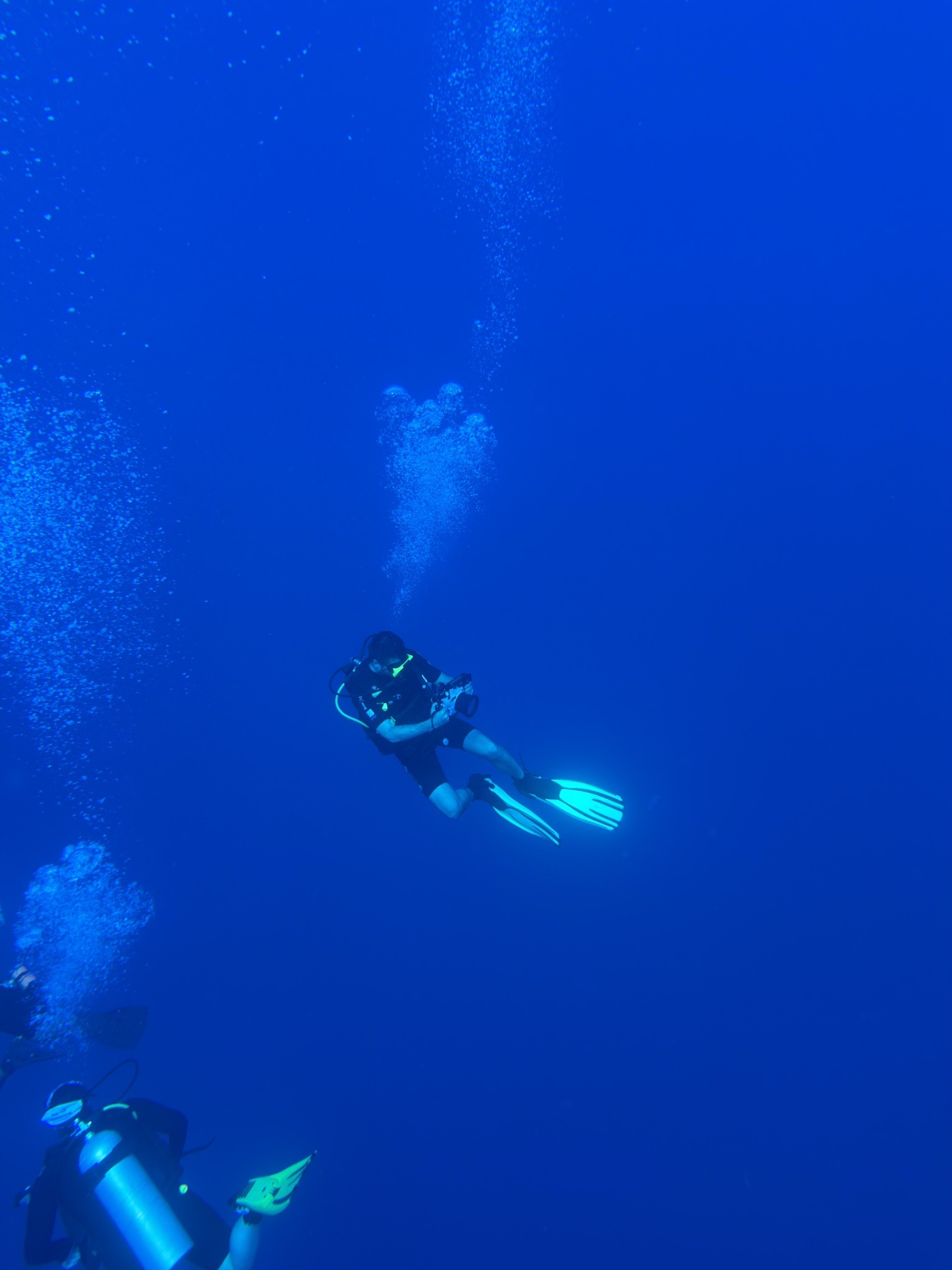
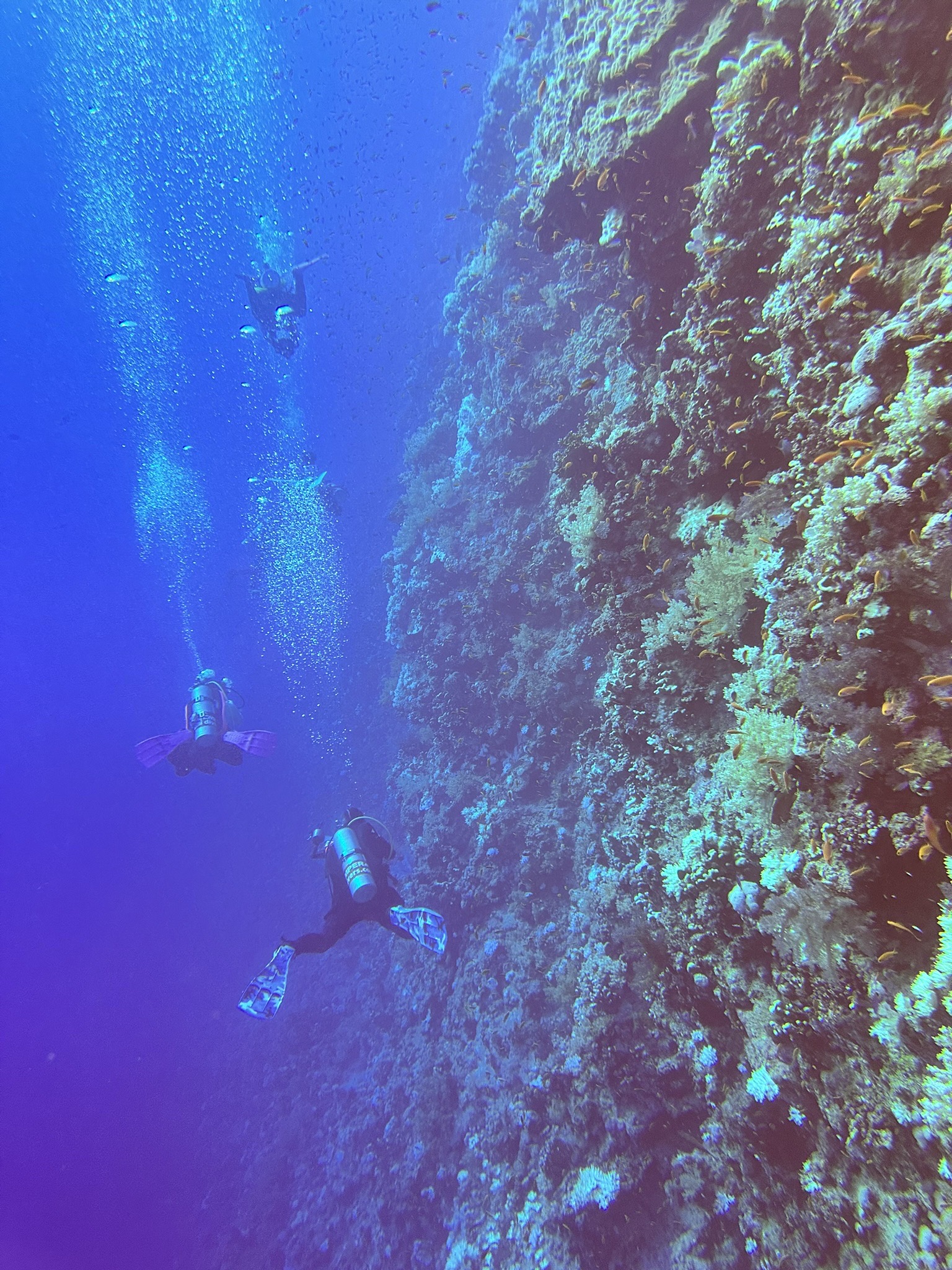
No - this page is the whole reef, both plateaus and both walls; the Elphinstone North record covers the northern plateau specifically. Elphinstone is a single cigar-shaped reef about 400 m long, and which end you dive changes the dive considerably.
The plateau at each tip sits between 20 and 40 m, and that is the recreational dive. From the plateau edges the eastern and western walls fall vertically past 100 m into open water, so the depth available is effectively unlimited and the depth planned has to be your own discipline.
Strong and near-permanent. The reef lies at an angle to the prevailing flow, so current runs over both plateaus almost all the time, generally north to south along the walls, and it is variable enough to reverse. Every dive is planned as a drift with a pickup in blue water, which is why a delayed SMB is not optional.
October to the end of December, on the southern plateau, usually with pilot fish in attendance. Grey reef sharks, giant trevally, barracuda and tuna work the plateaus more generally, and hammerheads are reported but described as very elusive.
No. Guides rate it intermediate to advanced, and the honest reasons are the near-permanent strong current, the vertical walls into open ocean with nothing to stop on downstream, and the blue-water pickup. Multiple fatalities have been recorded at this reef. Dive it when drift technique and SMB deployment are automatic.
It is an arch at the southern tip at roughly 52 to 70 m, and the 'sarcophagus' is a square block of rock rather than an artefact. It is outside recreational limits and divers have died attempting it without the training and gas it requires. Do not confuse it with the tunnel system on the southern side at about 30 to 35 m, which is a different and shallower feature - still an overhead environment.
Boat only - about an hour and a half by day boat from the Marsa Alam coast, or on a liveaboard itinerary; the reef is roughly 10 km offshore. Expect company: several day boats and liveaboards are typically moored on it through the day, on HEPCA mooring buoys rather than anchors.
No, and it matters. The OBIS occurrence records behind this site are ordinary northern Red Sea reef fish - surgeonfish, tangs, butterflyfish, anthias, rays - and contain none of the pelagics. Everything said here about oceanic whitetips, grey reef sharks and hammerheads is dive-guide reporting.
| Species | How often | Records |
|---|---|---|
| Acanthurus sohal | common | 308 |
| Zebrasoma desjardinii | common | 272 |
| Taeniura lymma | common | 271 |
| Pterois miles | common | 238 |
| Chaetodon semilarvatus | common | 238 |
| Thalassoma rueppellii | common | 235 |
| Chlorurus sordidus | common | 233 |
| Abudefduf vaigiensis | common | 230 |
| Pseudanthias squamipinnis | common | 230 |
| Paracirrhites forsteri | common | 214 |
| Heniochus intermedius | common | 214 |
| Arothron diadematus | common | 213 |
| Cephalopholis miniata | common | 205 |
| Rhinecanthus assasi | common | 196 |
| Pygoplites diacanthus | common | 183 |
| Naso elegans | common | 179 |
| Tridacna maxima | common | 166 |
| Chaetodon fasciatus | common | 166 |
| Amphiprion bicinctus | common | 162 |
| Balistoides viridescens | common | 162 |
| Cephalopholis argus | common | 155 |
| Scarus niger | common | 154 |
| Diodon hystrix | common | 154 |
| Gymnothorax javanicus | common | 150 |
| Arothron hispidus | common | 148 |
| Naso unicornis | common | 145 |
| Fistularia commersonii | common | 143 |
| Chaetodon austriacus | common | 143 |
| Zebrasoma xanthurum | common | 141 |
| Chaetodon auriga | common | 139 |
| Myripristis murdjan | common | 136 |
| Amblyglyphidodon indicus | common | 135 |
| Monotaxis grandoculis | common | 133 |
| Balistapus undulatus | common | 125 |
| Cheilinus lunulatus | common | 122 |
| Chaetodon paucifasciatus | common | 118 |
| Pomacentrus sulfureus | common | 110 |
| Ctenochaetus striatus | common | 110 |
| Halichoeres hortulanus | common | 108 |
| Coris aygula | common | 106 |
| Priacanthus hamrur | common | 99 |
| Dascyllus trimaculatus | common | 99 |
| Neoniphon sammara | common | 98 |
| Flavocaranx bajad | common | 95 |
| Bodianus anthioides | common | 95 |
| Scolopsis ghanam | common | 92 |
| Oxycheilinus digramma | common | 88 |
| Sargocentron caudimaculatum | common | 88 |
| Epibulus insidiator | common | 87 |
| Parapercis hexophtalma | common | 85 |
| Pycnochromis dimidiatus | common | 81 |
| Pseudodax moluccanus | common | 79 |
| Mulloidichthys vanicolensis | occasional | 76 |
| Scarus ferrugineus | occasional | 76 |
| Variola louti | occasional | 74 |
| Chromis viridis | occasional | 74 |
| Parupeneus forsskali | occasional | 73 |
| Coenobita scaevola | occasional | 71 |
| Dascyllus abudafur | occasional | 70 |
| Ostracion cubicum | occasional | 69 |
A fin-shaped shelf hanging off the north tip of an offshore ridge, dived as a drift in permanent current with open ocean underneath.
The southern plateau of Elphinstone: a soft-coral shelf at around 41 m with the Sarcophagus arch below it, at depths that have killed people.
Almost certainly a duplicate catalogue entry for Abu Dabab IV: the quietest of the numbered reefs, and the one with the coral cover to show for it.
Almost certainly a duplicate catalogue entry for Abu Dabbab V: the fifth of the numbered offshore reefs, sandy slope, coral blocks, swim-throughs.
The sixth and outermost of the numbered Sha'ab Abu Dabbab reefs, in the group a local dive guide says people rarely dive.
The fifth of the numbered Abu Dabbab reefs: a sandy slope with coral blocks and swim-throughs, and very little written about it.
SeaLog imports your dives from your dive computer or Apple Watch, tracks every animal you see, and keeps your logbook safe forever.
Download SeaLog