


Certification required
OW
 SeaLog
Philippines · reef · beginner
Malapascua's dusk mandarinfish dive: a shallow rubble slope that only matters in the last light of the day.
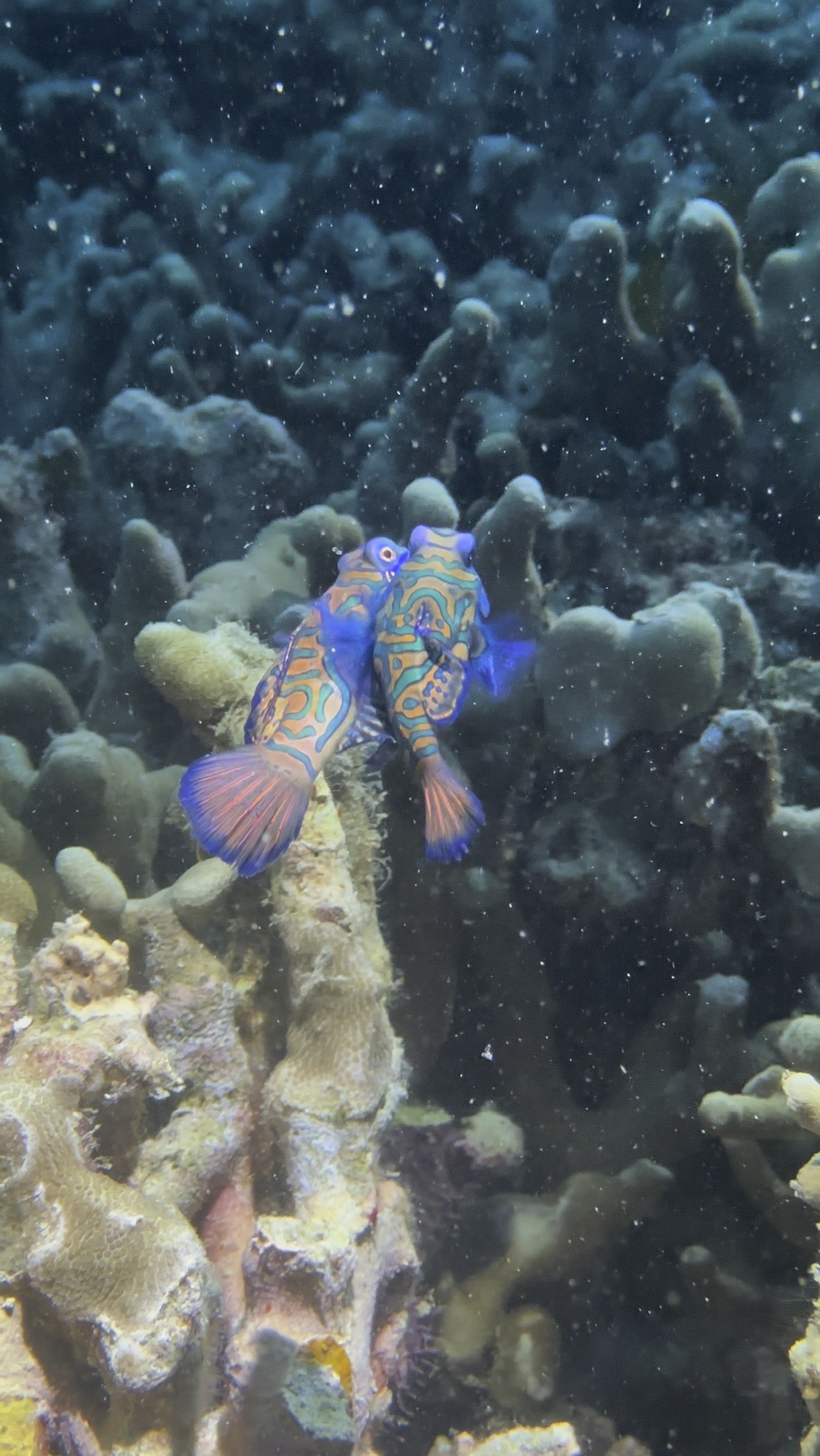
Lighthouse Reef is a shallow coral and rubble slope on sand off the northern side of Malapascua, five to fifteen minutes from the dive centres. Published depths run about 5 to 12 m. As a daytime dive it is unremarkable; the reason it is on every Malapascua schedule is that it is one of the most reliable places in the Philippines to watch mandarinfish spawn, which happens in the twenty minutes or so around sunset.
The dive is timed for that. Divers descend as the light goes and settle over the coral rubble waiting for the mandarinfish to emerge; a male and female rise together in a short spiral, release, and drop back into the coral. They are small, fast and skittish, and the sighting is not guaranteed. The rest of the site rewards the wait: tigertail seahorses on hard coral, banded and scribbled pipefish, juvenile sweetlips, bobtail squid, reef squid, cuttlefish, octopus, nudibranchs, shrimp, crabs, lionfish and banded sea snakes as the dive turns into a night dive. Blue-ringed octopus is occasionally reported.
This is not the thresher shark dive. Malapascua's threshers are at Monad Shoal, roughly thirty minutes away, and increasingly at Kimud Shoal, and both are pre-dawn deep-water dives with their own rules. Occurrence records drawn from a radius around Lighthouse pick up pelagic thresher from those shoals; that is an artefact of the search radius, not a species you should expect over this rubble slope. Do not book Lighthouse hoping for sharks.
What the occurrence records do support is the macro reputation: mandarinfish, tiger tail and thorny seahorses, pygmy seahorse, a long list of nudibranchs, anemone shrimp, porcelain crabs, striped eel catfish, snowflake moray, broadclub cuttlefish and harlequin sweetlips are all recorded in this stretch of reef.
OW
Boat dive from the Malapascua dive centres, five to fifteen minutes out depending on the operator, on the northern side of the island. It is run as a scheduled dusk departure rather than on demand, because the whole point is the sunset window - book it as part of the day's schedule.
Access to the site runs through a local operator.
We could not source a published marine-park fee, permit or written protected-area rule specific to Lighthouse Reef, so none is recorded here. Malapascua operators do collect assorted government and marine-park charges that vary by site and operator; ask your centre what applies to the dusk dive. Note that the Kimud Shoal rules that get quoted for Malapascua are that site's own MPA regime and do not attach to this one.
Mandarinfish spawn at dusk year round, so the site has no season of its own - what varies is whether the boat goes out. January to June is the dry season with calmer seas and the most reliable boat access; July to December brings rougher water and occasional cancellations, but fewer divers on the site. Whatever the month, the dive leaves in the late afternoon and the window is the twenty minutes around sunset.
Shallow coral and rubble on a sandy slope, 5 to 12 m, five to fifteen minutes by boat from the dive centres on the north side of Malapascua. The dive is timed to sunset, so you enter in fading light and finish in the dark. Water runs 26-29 C from March to December and 24-26 C in January and February. The dry season, January to June, gives calmer seas and 20-30 m visibility; July to December is rougher with occasional cancellations.
On current: No source publishes a current or visibility figure for Lighthouse specifically. Malapascua-wide figures are 20-30 m visibility in the January-June dry season and 15-30 m generally, but those are regional and the site is a shallow sandy rubble slope where silt matters more than water clarity - fin technique in the group ahead of you sets what you actually see. No ordinal is recorded for current.
No. Lighthouse is the shallow dusk mandarinfish dive on the north side of the island, 5 to 12 m on coral rubble. The threshers are at Monad Shoal, around thirty minutes away, and increasingly at Kimud Shoal; both are pre-dawn deep-water dives with their own requirements. If a species list for Lighthouse shows thresher sharks, it has bled in from those nearby shoals.
About 5 to 12 m over a coral and rubble slope on sand. Individual operators publish 7-10 m or simply 10 m. It is one of the shallowest dives on the schedule, which is part of why it works as a long, patient dusk dive.
It is timed to sunset. Boats leave in the late afternoon so divers are down and settled as the light fades, which is when the mandarinfish become active. The spawning window is short - roughly the twenty minutes around dusk - and the dive usually carries on into darkness afterwards.
No. They are small, fast and skittish, and operators are explicit that sightings are not guaranteed. Lighthouse is one of the more reliable places to try, and the spiral spawning ascent is rarer still than simply seeing the fish. Budget more than one attempt if it matters to you.
Yes, with a caveat. The depth and the certification requirement are modest - PADI Open Water is the minimum for Malapascua diving - but it is a dusk dive that ends in the dark over silty rubble, with a group hovering in one place. If your buoyancy is not settled you will silt out the site for everyone.
Tigertail seahorses on the hard coral, scribbled and banded pipefish, juvenile sweetlips, nudibranchs, shrimp and crabs, lionfish, banded sea snakes, and as it turns to night bobtail squid, reef squid, cuttlefish and octopus. Blue-ringed octopus is occasionally reported.
Not usefully. The reef is shallow enough in principle, but the entire attraction happens after sunset, down in the coral, and needs a light held close and steady. No operator sells it as a snorkelling site.
Mandarinfish spawn at dusk all year, so the site has no season of its own. What changes is the boat: January to June is the dry season, with calmer seas, 20-30 m visibility and the most reliable departures, while July to December is rougher with occasional cancellations and fewer divers on the site.
| Species | How often | Records |
|---|---|---|
| Thuridilla lineolata | common | 120 |
| Alopias pelagicus | common | 118 |
| Elysia marginata | common | 90 |
| Nembrotha kubaryana | common | 73 |
| Phyllidia coelestis | common | 62 |
| Hippocampus comes | common | 61 |
| Amphiprion clarkii | common | 60 |
| Triaenodon obesus | common | 57 |
| Phyllidia varicosa | common | 57 |
| Plotosus lineatus | common | 55 |
| Hypselodoris variobranchia | common | 54 |
| Synchiropus splendidus | common | 53 |
| Thor amboinensis | common | 50 |
| Dardanus pedunculatus | common | 50 |
| Ancylocaris brevicarpalis | common | 50 |
| Coriocella nigra | occasional | 49 |
| Nembrotha cristata | occasional | 48 |
| Neopetrolisthes maculatus | occasional | 48 |
| Hippocampus histrix | occasional | 47 |
| Halgerda batangas | occasional | 45 |
| Echinothrix calamaris | occasional | 44 |
| Nembrotha milleri | occasional | 42 |
| Chromodoris magnifica | occasional | 42 |
| Protoreaster nodosus | occasional | 41 |
| Echidna nebulosa | occasional | 41 |
| Phyllidia elegans | occasional | 40 |
| Linckia laevigata | occasional | 40 |
| Diadema setosum | occasional | 40 |
| Lactoria fornasini | occasional | 39 |
| Dardanus lagopodes | occasional | 39 |
| Tambja morosa | occasional | 38 |
| Ceratosoma gracillimum | occasional | 37 |
| Arothron mappa | occasional | 36 |
| Hippocampus bargibanti | occasional | 35 |
| Diademichthys lineatus | occasional | 34 |
| Plectorhinchus chaetodonoides | occasional | 33 |
| Ascarosepion latimanus | occasional | 32 |
| Arothron manilensis | occasional | 32 |
| Amphiprion frenatus | occasional | 32 |
| Pearsonothuria graeffei | occasional | 32 |
| Toxopneustes pileolus | occasional | 31 |
| Odontodactylus scyllarus | occasional | 30 |
| Eurypegasus draconis | occasional | 30 |
| Arothron hispidus | occasional | 30 |
| Dolabella auricularia | occasional | 30 |
| Thalassoma lunare | occasional | 30 |
| Pteraeolidia semperi | occasional | 29 |
| Culcita novaeguineae | occasional | 29 |
| Echinometra mathaei | occasional | 29 |
| Solenostomus paradoxus | occasional | 29 |
| Amphiprion ocellaris | occasional | 29 |
| Cirrhilabrus ryukyuensis | occasional | 28 |
| Coryphellina exoptata | occasional | 28 |
| Phyllodesmium briareum | occasional | 28 |
| Hypselodoris bullockii | occasional | 26 |
| Dunckerocampus dactyliophorus | occasional | 25 |
| Halichoeres scapularis | occasional | 25 |
| Pseudomonacanthus macrurus | occasional | 24 |
| Arothron nigropunctatus | occasional | 24 |
| Actinopyga echinites | occasional | 23 |
SeaLog imports your dives from your dive computer or Apple Watch, tracks every animal you see, and keeps your logbook safe forever.
Download SeaLog