


Certification required
OW
 SeaLog
Egypt · reef · beginner
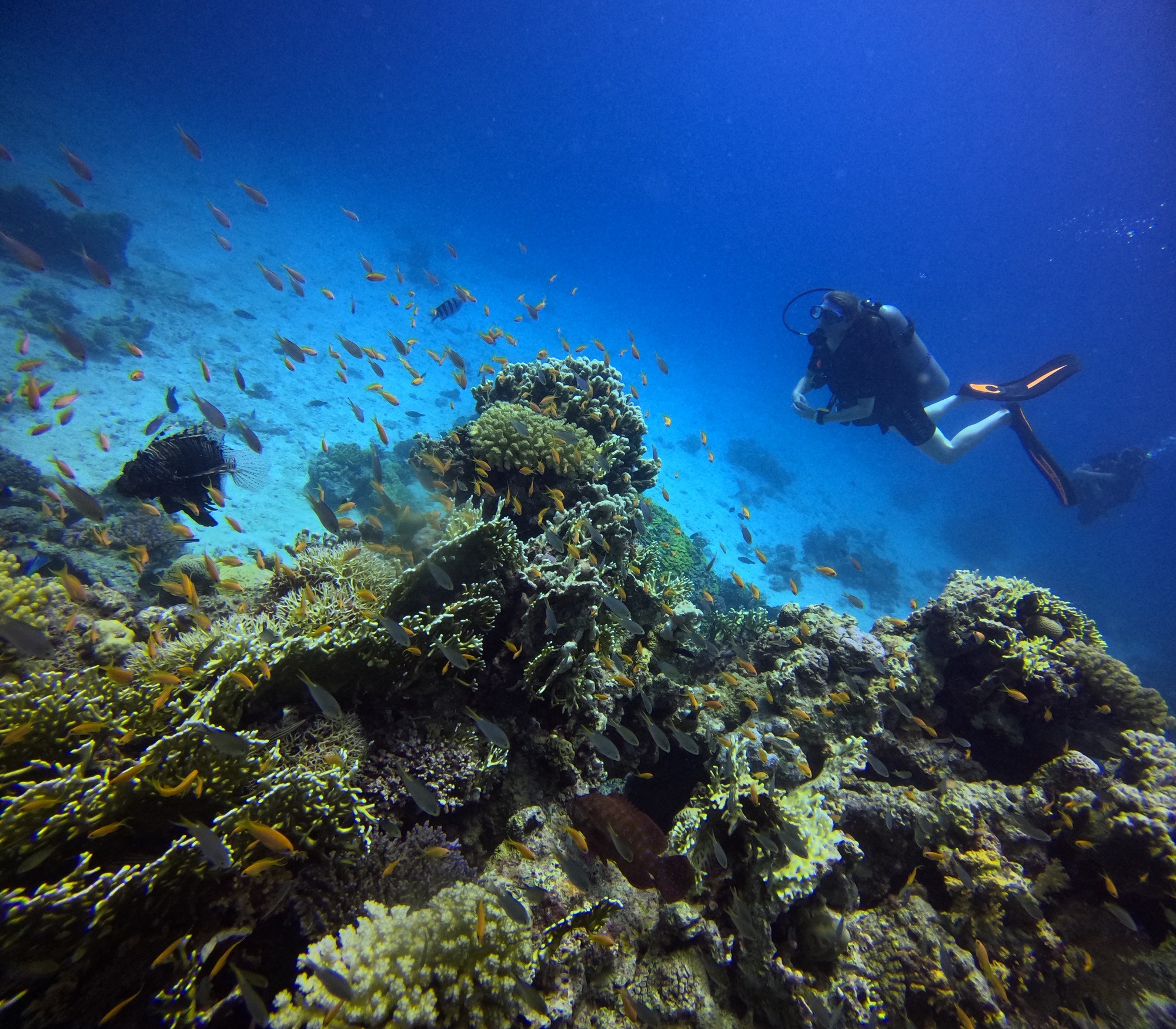
The southern end of the long El Fanadir reef, where the sandy plateau widens out before the second wall drops away.
El Fanadir is one reef, roughly 3 km long, lying off the coast north of Hurghada. Dive centres split it into two separate sites and this pin is the southern one, so what you dive here is the south end of that single reef rather than a stand-alone pinnacle. The structure is consistent along it: a coloured wall on the seaward side running down to about 10 to 15 m, a sandy plateau at the foot of that wall, and beyond the plateau a second and steeper wall that carries on past 40 m. What distinguishes the southern end specifically is the plateau itself, which is narrow further up the reef and widens as you work south until it ends at the drop-off.
A normal dive drops on the wall, works along it and then out onto the plateau, where isolated coral blocks sit on open sand. Operators quote the site as roughly 12 to 40 m; logged profiles reported by dive guides cluster in the 20 to 33 m band, and there is little reason to push deep because the coral blocks, the cleaning stations and most of the life sit shallower than the sand. Expect lionfish hanging off the wall, scorpionfish and false stonefish sitting still on the sand where you have to look twice to find them, morays wedged into the reef, day octopus in the rubble, and blue-spotted ribbontail rays working the plateau edge. Over the hard coral there are sea goldies, twoband anemonefish in their host anemones and yellowbar angelfish.
Access is by day boat from Hurghada or El Gouna, roughly 30 to 60 minutes depending on which marina you leave from, and HEPCA maintains mooring buoys on the Fanadir reef so boats tie up rather than anchor. Current is usually light and, when it runs, it sets north to south along the reef, which makes an easy one-way drift; it can pick up in the channel and a briefing here is worth listening to. Because the site is sheltered and shallow work is the good part, it is a common night-dive choice out of Hurghada.
OW
Day boat from Hurghada or El Gouna, about 30 to 60 minutes depending on the marina. Boats tie to HEPCA mooring buoys on the Fanadir reef rather than anchoring. There is no shore entry.
Access to the site runs through a local operator.
The Egyptian Red Sea's Great Fringing Reef, which includes the mainland fringing reefs of the Red Sea Governorate, was declared a marine protected area by Prime Ministerial Decree No. 4419 of 6 December 2025. The published reports do not include the boundary coordinates, so whether this particular reef falls inside the new boundary is not something we have confirmed, and no diver fee or permit scheme had been announced in them. Check with your operator.
March to May and October to November are the settled months on this coast: water at 25 to 27 C, visibility back above 30 m, and light winds so boats actually run. Winter northwesterlies can shut down exposed sites, though a near-shore reef like this one stays diveable and winter visibility on the shallow reefs is often the best of the year.
A normal day is a boat ride of half an hour to an hour from Hurghada or El Gouna, light current, and visibility around 20 m, with 30 m on the better days. Water runs roughly 21 C in February to 29 C in August on the Hurghada coast.
On current: Sources do not fully agree. A dive guide that aggregates logged dives at El Fanadir records current as limited; other descriptions call it a gentle drift running north to south along the reef, and one notes that current in the strait can occasionally be strong enough to make it a genuine drift dive. Plan for light current and treat the stronger case as the one you brief for.
Best months: Mar, Apr, May, Oct, Nov
Dive centres list the site at roughly 12 to 40 m. The reef wall runs down to about 10 to 15 m where the sandy plateau begins, and a second, steeper wall drops from the outer edge of that plateau past 40 m. Logged dives reported by dive guides mostly sit in the 20 to 33 m band, and there is no need to go deeper than about 30 m because the coral blocks and cleaning stations are shallower than the sand.
They are two dive sites on the same reef, which runs roughly 3 km off the coast north of Hurghada. The south is the end where the sandy plateau is at its widest, spreading out from the base of the wall before ending at the drop-off; further north the same plateau is narrower. Boats normally do them as separate dives rather than covering the whole reef in one.
Yes. Operators list it as suitable for all levels from Open Water upward, and the parts worth diving are the wall and the shallow coral blocks rather than the deep sand. Current is usually light, the reef is sheltered, and boats tie to a mooring so there is a line to ascend on.
You can snorkel the reef top and upper wall from the boat, but there is no shore access, so you need to be on a dive or snorkel trip to get there in the first place. The features that make it a dive, the plateau and the second wall, start well below snorkelling depth, so a snorkeller sees only the top of the reef.
Usually only light current. When it does run it sets north to south along the reef, which makes for an easy one-way drift, and some operators sell the site that way. Sources are not unanimous: one guide records current as limited, another notes it can occasionally be strong in the strait, so treat the stronger case as the one to brief for.
Lionfish along the wall, morays wedged into the reef, day octopus in the rubble and blue-spotted ribbontail rays out on the sandy plateau. Scorpionfish and false stonefish sit motionless on the sand and on the coral blocks and take some finding. Over the hard coral expect sea goldies, twoband anemonefish and yellowbar angelfish.
By day boat from Hurghada or El Gouna, roughly 30 to 60 minutes out depending on which marina you leave from. HEPCA maintains mooring buoys on the Fanadir reef, so the boat ties up rather than dropping an anchor. There is no shore entry.
March to May and October to November are the most settled months on this coast, with water at 25 to 27 C, visibility back above 30 m and light enough winds that boats run reliably. Winter northwesterlies can close exposed offshore sites, but a near-shore reef like this one still gets dived and shallow-water visibility in winter is often the clearest of the year.
| Species | How often | Records |
|---|---|---|
| Taeniura lymma | occasional | 9 |
| Amphiprion bicinctus | occasional | 9 |
| Pterois miles | occasional | 9 |
| Fistularia commersonii | occasional | 8 |
| Parapercis hexophtalma | occasional | 7 |
| Octopus cyanea | occasional | 7 |
| Arothron hispidus | occasional | 7 |
| Scolopsis ghanam | occasional | 6 |
| Pseudanthias squamipinnis | occasional | 6 |
| Pomacanthus maculosus | occasional | 6 |
| Abudefduf sexfasciatus | occasional | 6 |
| Gymnothorax javanicus | occasional | 5 |
| Bodianus anthioides | occasional | 5 |
| Cheilinus abudjubbe | occasional | 5 |
| Dascyllus marginatus | occasional | 5 |
| Gymnothorax nudivomer | occasional | 5 |
| Cephalopholis miniata | rare | 4 |
| Naso unicornis | rare | 4 |
| Variola louti | rare | 4 |
| Hipposcarus harid | rare | 4 |
| Myripristis murdjan | rare | 4 |
| Diodon hystrix | rare | 4 |
| Abudefduf vaigiensis | rare | 4 |
| Parupeneus forsskali | rare | 4 |
| Callyspongia (Callyspongia) siphonella | rare | 3 |
| Zebrasoma xanthurum | rare | 3 |
| Cephalopholis argus | rare | 3 |
| Lethrinus nebulosus | rare | 3 |
| Chlorurus sordidus | rare | 3 |
| Chaetodon larvatus | rare | 3 |
| Epibulus insidiator | rare | 3 |
| Chromodoris quadricolor | rare | 3 |
| Pycnochromis dimidiatus | rare | 3 |
| Coris aygula | rare | 3 |
| Cheilinus quinquecinctus | rare | 3 |
| Arothron diadematus | rare | 3 |
| Canthigaster cyanospilota | rare | 3 |
| Amblyeleotris steinitzi | rare | 2 |
| Chaetodon fasciatus | rare | 2 |
| Anampses meleagrides | rare | 2 |
| Grammistes sexlineatus | rare | 2 |
| Cheilinus lunulatus | rare | 2 |
| Cheilodipterus macrodon | rare | 2 |
| Ctenochaetus striatus | rare | 2 |
| Dascyllus trimaculatus | rare | 2 |
| Gymnothorax flavimarginatus | rare | 2 |
| Amblyglyphidodon indicus | rare | 2 |
| Canthigaster margaritata | rare | 2 |
| Heniochus intermedius | rare | 2 |
| Neoniphon sammara | rare | 2 |
| Calotomus viridescens | rare | 2 |
| Platax orbicularis | rare | 2 |
| Balistapus undulatus | rare | 2 |
| Pygoplites diacanthus | rare | 2 |
| Sargocentron caudimaculatum | rare | 2 |
| Scorpaenopsis diabolus | rare | 2 |
| Parupeneus macronemus | rare | 2 |
| Sufflamen albicaudatum | rare | 2 |
| Thalassoma rueppellii | rare | 2 |
| Tursiops aduncus | rare | 2 |
The exposed northern end of Fanadir's long offshore reef: a coral wall to a sand shelf at 12 m, then a slope that runs parallel to it from 18 m past 30 m.
A small round gota on the Abu Galawa reef south of El Gouna: shallow coral banks in the northeast, stony-coral canyons through the middle, and free-standing ergs on sand to the southwest.
The bay dive on the Abu Galawa reef: a seagrass lagoon at 5 m behind a coral drop-off, worked slowly for small camouflaged things.
The northernmost of the named dives on the Abu Galawa reef: a drift along the wall onto a small plateau, with glassfish and anthias packed onto the coral towers.
An Egyptian T-43 minesweeper bombed at anchor off Hurghada in February 1970, lying on her port side with her guns, screws and blast hole still in place between 19 and 32 m.
A 22 m twin-masted safari boat that burned and sank off Hurghada in the mid-1990s, sitting upright on sand a short swim from the beach.
SeaLog imports your dives from your dive computer or Apple Watch, tracks every animal you see, and keeps your logbook safe forever.
Download SeaLog