


Certification required
AOW
 SeaLog
Philippines · reef · intermediate
The deep north-east slope of Balicasag, named for the black coral that starts below 35 m.
Black Forest sits on the north-east side of Balicasag, a small island in a marine sanctuary about 12 km and half an hour by boat from Alona Beach on Panglao. The dive begins over sandy shallows with coral heads and patches of seagrass where green turtles feed, then follows the slope down. Operators publish the workable range as roughly 8 to 40 m; the black corals the site is named for are described as growing at about 35 to 45 m, so most of what the name refers to is at or past the recreational limit. When current runs it is dived as a drift.
It shares the north-east drop-off with Royal Garden, and boats often work both on the same day. The honest distinction is depth rather than geography: Royal Garden is the shallow plateau and coral garden around 18 m, Black Forest is the slope below it. Schooling jackfish, barracuda and trevally are reported along the deeper part, and whitetip reef sharks are described resting in small caves in the slope.
Access is not open. A Panglao municipal ordinance caps Balicasag at 300 dives per day, roughly 150 divers, with a maximum of two dives each, allocated first come first served through an Advance Reservation System; the 2020 carrying-capacity scheme also puts 60 visitors per day on each of the five dive points. You cannot turn up and dive it, and reservations are frequently full.
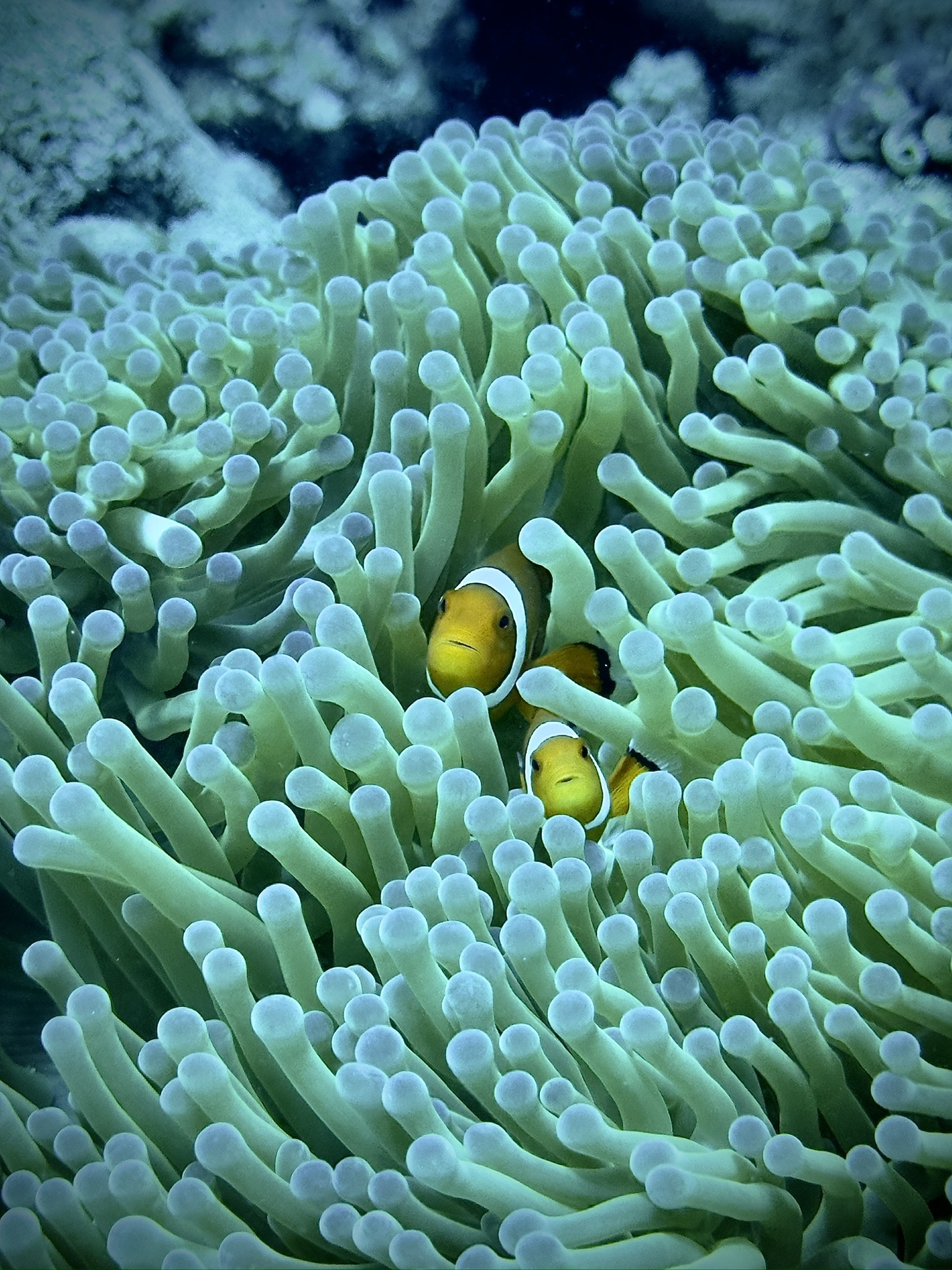
Occurrence records for the reef are dominated by reef and macro fauna rather than the pelagics the site is sold on: horned sea star, several Nembrotha and Chromodoris nudibranchs, Clark's, tomato, false clown and pink anemonefish, whitemouth moray, regal angelfish, Moorish idol, blackspotted and map puffers, and giant frogfish. The jackfish tornado is a real feature of the north-east side, but it is a school that has to be found, not a fixture.
AOW
Boat only, about 12 km and 30 minutes from Alona Beach on Panglao. Trips run through Panglao dive centres because the slot allocation does; your centre files a Comprehensive Dive Reservation Form with every diver's name, certification level and nationality, plus certification copies. Reservations open up to three months ahead and are often already full a day or two out, so book with the centre well before you arrive.
Access to the site runs through a local operator.
A Panglao municipal ordinance caps Balicasag at 300 dives per day, approximately 150 divers, with a maximum of two dives per diver per day, shared between all operators first come first served through the Advance Reservation System. The 2020 carrying-capacity scheme additionally allows 60 visitors per day at each of the five dive points. Island-hopping and snorkelling boats must leave from the Panglao jetty port; diving is exempt from that gateway rule but not from the cap.
Balicasag is a marine sanctuary. Operators publish an environmental user fee of PHP 250 per diver per day for Balicasag plus a PHP 300 per day mooring fee shared across the boat; check current amounts with your centre, since these are operator-published figures rather than an ordinance text. We could not source a written rule making an in-water guide compulsory, so that field is left unanswered - in practice every Panglao operator dives it guided.
January to May, the dry season, is when visibility peaks at 15-30 m and the crossing is calmest. The low season from May to October is still diveable with 10-20 m visibility. Christmas, New Year and Easter are worth avoiding: the daily dive cap does not increase for the holidays, so the reservation system fills.
A sloping reef off an exposed island, dived from a day boat out of Alona Beach. Sandy, coral-headed shallows give onto a slope that keeps going past 40 m. Published visibility averages about 20 m, better in the January-May dry season at 15-30 m and 10-20 m during the rains. Water runs about 26-27 C from January to March and up to around 29 C later in the year. Current is inconsistent between sources and the dive is often run as a drift.
On current: Sources disagree sharply. One site record logs the current as limited and rates the dive easy; a Panglao operator calls Black Forest advanced only because of strong currents, and a regional guide says currents can be strong at island sites like Balicasag and that the site is often run as a drift. We take the conservative reading: plan for a drift with possible strong current, and treat the easy rating as the best case rather than the baseline. Visibility is published as 10-30 m with a 20 m average, and seasonally as 15-30 m in the January-May dry season against 10-20 m in the rains.
Operators publish a working range of roughly 8 to 40 m. The sandy shallows and coral heads start at about 8 m and the slope runs past 40. The black corals that give the site its name are described at 35 to 45 m, which is at or beyond the recreational limit, so plan the dive rather than chase the name.
Yes. A Panglao municipal ordinance limits Balicasag to 300 dives a day, about 150 divers, with a maximum of two dives per diver, allocated first come first served through an Advance Reservation System. Your dive centre files a Comprehensive Dive Reservation Form with each diver's name, certification level and nationality and attaches certification copies. Slots can be booked up to three months out and are often full a couple of days before.
Panglao operators publish an environmental user fee of PHP 250 per diver per day for Balicasag plus a PHP 300 per day mooring fee shared across the boat, on top of the dive package. Those are operator-published figures, not an ordinance text, so confirm the current amounts when you book.
Sources disagree, and we take the conservative side. One site record rates it an easy boat dive with limited current; a Panglao operator lists it as advanced only because of strong currents. The shallow part is manageable for a newly certified diver with a guide, but the slope, the depth and the frequent drift profile make it an advanced dive in practice. Royal Garden next door is the shallower answer.
No. Balicasag has two designated snorkelling sites with their own daily capacity of 200 people each, and island-hopping and snorkelling boats must depart from the Panglao jetty port. Black Forest is one of the five regulated dive points, and everything it is known for sits below snorkelling depth.
Black coral on the deep slope, schooling jackfish, barracuda and trevally along the drop-off, green turtles over the seagrass patches in the shallows, and whitetip reef sharks resting in small caves. Occurrence records for the reef are dominated by more ordinary residents: anemonefish, nudibranchs, moray, regal angelfish, puffers and frogfish. The jackfish tornado is real but it is a school you have to find.
January to May, the dry season, gives the calmest crossing and 15-30 m visibility. May to October still dives well with 10-20 m. Avoid Christmas, New Year and Easter: the daily dive cap does not rise for the holidays, so the reservation system simply fills up.
They are on the same north-east drop-off and boats often do both in a day. Royal Garden is the shallow plateau and coral garden around 18 m where turtles graze; Black Forest is the slope below it, running to 40 m and beyond, with the black coral and the pelagic schools. Depth is the real difference, not location.
| Species | How often | Records |
|---|---|---|
| Protoreaster nodosus | common | 83 |
| Chromodoris annae | common | 56 |
| Nembrotha kubaryana | common | 55 |
| Amphiprion clarkii | common | 54 |
| Amphiprion frenatus | common | 51 |
| Amphiprion ocellaris | occasional | 49 |
| Dascyllus trimaculatus | occasional | 46 |
| Gymnothorax thyrsoideus | occasional | 40 |
| Linckia laevigata | occasional | 40 |
| Pseudanthias huchtii | occasional | 35 |
| Lutjanus biguttatus | occasional | 35 |
| Pygoplites diacanthus | occasional | 33 |
| Pearsonothuria graeffei | occasional | 32 |
| Dascyllus reticulatus | occasional | 32 |
| Arothron nigropunctatus | occasional | 32 |
| Zanclus cornutus | occasional | 32 |
| Nembrotha chamberlaini | occasional | 32 |
| Antennarius commerson | occasional | 27 |
| Phyllidia elegans | occasional | 27 |
| Phyllodesmium briareum | occasional | 26 |
| Amblyglyphidodon aureus | occasional | 25 |
| Arothron mappa | occasional | 25 |
| Pseudanthias tuka | occasional | 24 |
| Amphiprion perideraion | occasional | 24 |
| Dascyllus aruanus | occasional | 23 |
| Halichoeres scapularis | occasional | 23 |
| Lyrodus pedicellatus | occasional | 23 |
| Nembrotha cristata | occasional | 23 |
| Chelidonura varians | occasional | 23 |
| Heniochus varius | occasional | 23 |
| Pterois volitans | occasional | 23 |
| Dardanus lagopodes | occasional | 22 |
| Coenobita rugosus | occasional | 22 |
| Echinothrix calamaris | occasional | 22 |
| Culcita novaeguineae | occasional | 21 |
| Didemnum molle | occasional | 21 |
| Nembrotha lineolata | occasional | 19 |
| Chaetodon baronessa | occasional | 19 |
| Odontodactylus scyllarus | occasional | 18 |
| Canthigaster valentini | occasional | 18 |
| Abudefduf vaigiensis | occasional | 18 |
| Thalassoma hardwicke | occasional | 18 |
| Neopetrolisthes maculatus | occasional | 18 |
| Ardeadoris egretta | occasional | 17 |
| Tripneustes gratilla | occasional | 17 |
| Pleurobranchus forskalii | occasional | 17 |
| Cirrhitichthys falco | occasional | 17 |
| Halgerda batangas | occasional | 17 |
| Phyllidia varicosa | occasional | 16 |
| Scolopsis bilineata | occasional | 16 |
| Heteroconger hassi | occasional | 16 |
| Plotosus lineatus | occasional | 16 |
| Cephalopholis argus | occasional | 16 |
| Cheilio inermis | occasional | 16 |
| Halichoeres hortulanus | occasional | 16 |
| Caesio caerulaurea | occasional | 16 |
| Genicanthus lamarck | occasional | 16 |
| Rastrelliger kanagurta | occasional | 15 |
| Thor amboinensis | occasional | 15 |
| Archaster typicus | occasional | 15 |
SeaLog imports your dives from your dive computer or Apple Watch, tracks every animal you see, and keeps your logbook safe forever.
Download SeaLog