


Certification required
OW
 SeaLog
Egypt · reef · beginner
The long, gently sloping coral garden on the south side of the Soma Bay headland - the easy dive of the bay.
Abu Soma Garden is the coral garden that runs south from the Ras Abu Soma headland, part of the same reef system as Ras Abu Soma itself and the Breakers house reef a few hundred metres away. It is the gentle member of the group: a long reef that descends gradually from the shallows, with sandy patches at depth between the coral.
PADI publishes a 1 to 30 m range for it and boat entry, with Open Water as the minimum certification. In practice most of the dive is spent much shallower than that maximum, working the coral along the slope, and drift diving is on the list of what the site suits when the northerly current is running.
Our OBIS records for this position are ordinary northern Red Sea reef fauna and read almost identically to Ras Abu Soma and Gamul Kebir nearby: two-band anemonefish, bluespotted ribbontail ray, giant moray, common lionfish, bullethead parrotfish, sailfin tang, scalefin anthias, giant clam, masked butterflyfish and Red Sea bannerfish. Dive-centre accounts add eagle rays, barracuda and crocodilefish on the sand.
OW
Boat entry per PADI. It sits on the south side of the Ras Abu Soma headland, a short run from the Soma Bay and Safaga dive centres; one operator quotes about 45 minutes by boat from Safaga for the headland as a whole and sets a minimum group size of 12 divers.
Access to the site runs through a local operator.
A long reef descending gradually from about 1 m to a maximum around 30 m, with sand between the coral at the deep end. Current usually slight, setting from the north across the headland, occasionally enough for a one-way drift. No published visibility figure, so none is recorded.
On current: No source publishes a current figure for the garden specifically. The headland it belongs to has a main current set from the north that is usually slight and sometimes enough for a gentle drift, and PADI lists drift diving among the site's suitable specialties. No published visibility figure, so none is recorded.
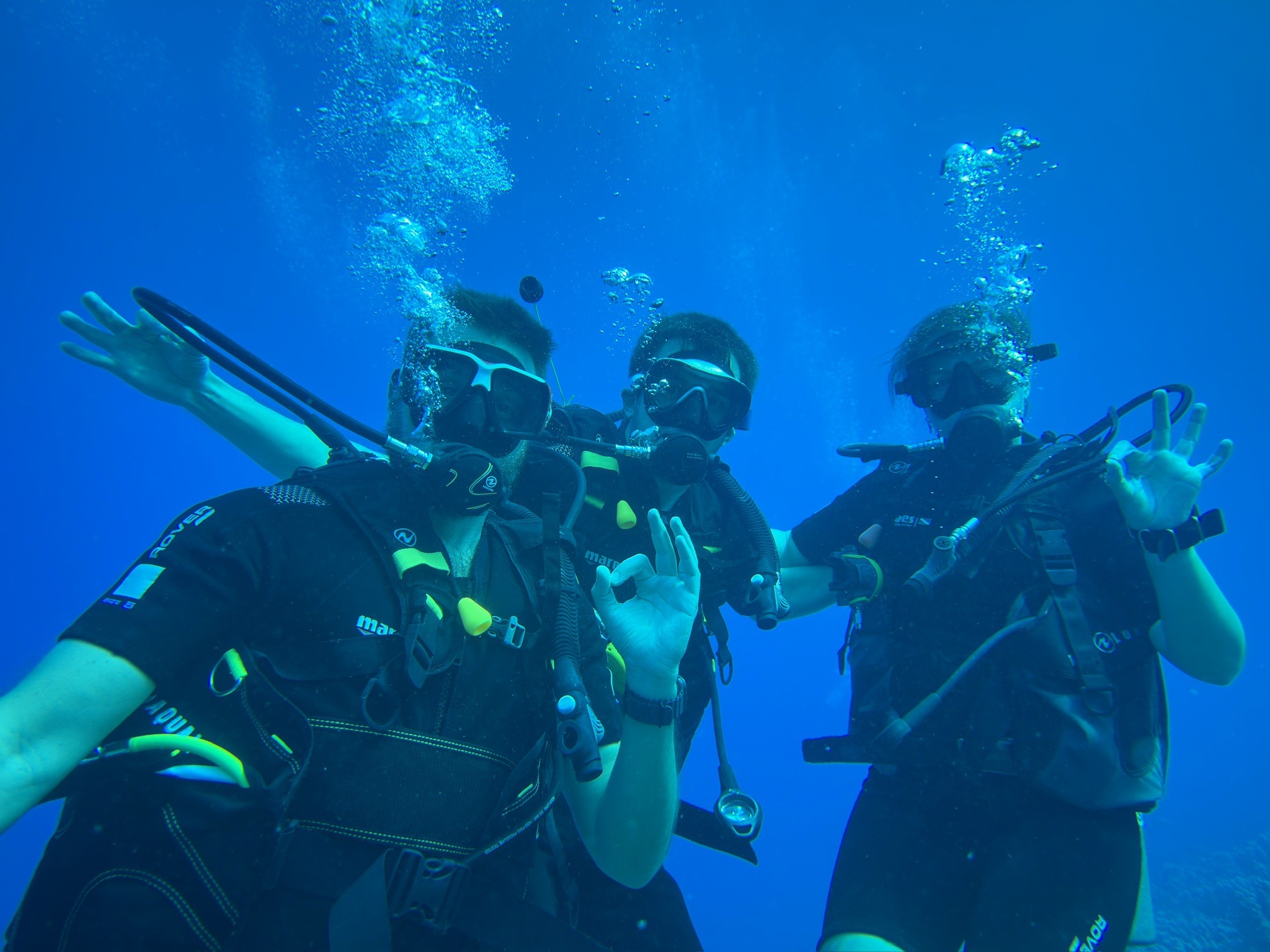
PADI publishes 1 to 30 m. The reef begins in the shallows and slopes down gradually to sand at the deep end, so the maximum is the bottom of the slope rather than the shape of the dive - most of the time here is spent much shallower.
It is the gentle one of the Soma Bay group. Open Water is the stated minimum, the slope is gradual with no wall to drop off, and the current is usually slight. If you are shaking off rust at the start of a trip, this is a sensible choice.
By boat, on the south side of the Ras Abu Soma headland - a short run from the Soma Bay resorts, or about 45 minutes from Safaga. One operator only runs the headland trip with a minimum of 12 divers.
Usually slight. The main set across the headland comes from the north, and when it runs the dive can be done as a gentle one-way drift - PADI lists drift diving among the specialties this site suits.
Coral rather than pelagics. Our OBIS records here are standard Red Sea reef fauna - anemonefish, bluespotted ribbontail rays, giant morays, lionfish, parrotfish, sailfin tangs, anthias and giant clams. Dive-centre accounts add eagle rays, barracuda, and crocodilefish lying on the sandy patches at the deep end.
They are the same reef system around one headland. Ras Abu Soma is the point itself, with the steep wall and the 25 m plateau; the Breakers house reef is the shore-accessible southern section reached along the dive centre's jetty; Abu Soma Garden is the long, gradual coral slope in between. Same water, three different dives.
| Species | How often | Records |
|---|---|---|
| Amphiprion bicinctus | common | 50 |
| Taeniura lymma | occasional | 49 |
| Gymnothorax javanicus | occasional | 40 |
| Pterois miles | occasional | 39 |
| Chlorurus sordidus | occasional | 39 |
| Zebrasoma desjardinii | occasional | 39 |
| Pseudanthias squamipinnis | occasional | 37 |
| Tridacna maxima | occasional | 35 |
| Chaetodon semilarvatus | occasional | 35 |
| Heniochus intermedius | occasional | 34 |
| Epibulus insidiator | occasional | 33 |
| Paracirrhites forsteri | occasional | 33 |
| Thalassoma rueppellii | occasional | 32 |
| Chaetodon austriacus | occasional | 30 |
| Arothron diadematus | occasional | 29 |
| Pygoplites diacanthus | occasional | 28 |
| Arothron hispidus | occasional | 27 |
| Parapercis hexophtalma | occasional | 27 |
| Cheilinus lunulatus | occasional | 26 |
| Rhinecanthus assasi | occasional | 26 |
| Fistularia commersonii | occasional | 25 |
| Ctenochaetus striatus | occasional | 25 |
| Naso elegans | occasional | 25 |
| Arothron stellatus | occasional | 23 |
| Scarus niger | occasional | 22 |
| Acanthurus sohal | occasional | 21 |
| Scarus ferrugineus | occasional | 21 |
| Myripristis murdjan | occasional | 21 |
| Abudefduf vaigiensis | occasional | 21 |
| Chaetodon fasciatus | occasional | 20 |
| Chaetodon auriga | occasional | 20 |
| Ostracion cubicum | occasional | 20 |
| Dascyllus abudafur | occasional | 20 |
| Coris aygula | occasional | 19 |
| Priacanthus hamrur | occasional | 18 |
| Neoniphon sammara | occasional | 18 |
| Parupeneus forsskali | occasional | 18 |
| Amblyglyphidodon indicus | occasional | 17 |
| Pseudobalistes fuscus | occasional | 16 |
| Naso unicornis | occasional | 16 |
| Chlorurus gibbus | occasional | 16 |
| Bodianus anthioides | occasional | 16 |
| Chaetodon paucifasciatus | occasional | 16 |
| Monotaxis grandoculis | occasional | 16 |
| Plectorhinchus gaterinus | occasional | 16 |
| Zebrasoma xanthurum | occasional | 16 |
| Chaetodon melannotus | occasional | 15 |
| Pomacentrus sulfureus | occasional | 15 |
| Halichoeres hortulanus | occasional | 15 |
| Cephalopholis argus | occasional | 14 |
| Cheilinus quinquecinctus | occasional | 14 |
| Siganus luridus | occasional | 14 |
| Ophiocoma scolopendrina | occasional | 14 |
| Dascyllus trimaculatus | occasional | 14 |
| Acanthopleura vaillantii | occasional | 14 |
| Pomacanthus imperator | occasional | 14 |
| Abudefduf sexfasciatus | occasional | 13 |
| Mulloidichthys vanicolensis | occasional | 13 |
| Octopus cyanea | occasional | 13 |
| Sargocentron caudimaculatum | occasional | 13 |
A hard-coral drop-off reached on foot down a 420 m jetty, shallow enough to stay down for an hour and a half.
The headland that closes Soma Bay: a wall down one side, a 25 m plateau at the tip, and table corals the size of a car.
Seven coral pillars standing off the sand in the lee of the Soma Bay headland, none of them deeper than about 15 m.
The shore reef off ROBINSON Club's own beach on the Soma Bay peninsula, dived from the sand rather than from the famous jetty a kilometre and a half away.
The drift entry for the Ras Abu Soma headland - almost certainly the same reef as our Ras Abu Soma page, listed twice.
SeaLog imports your dives from your dive computer or Apple Watch, tracks every animal you see, and keeps your logbook safe forever.
Download SeaLog