


Certification required
OW
 SeaLog
Italy · beginner
A freshwater shore dive on the north shore of Lake Bracciano, where 18 m arrives within a few metres of the beach.
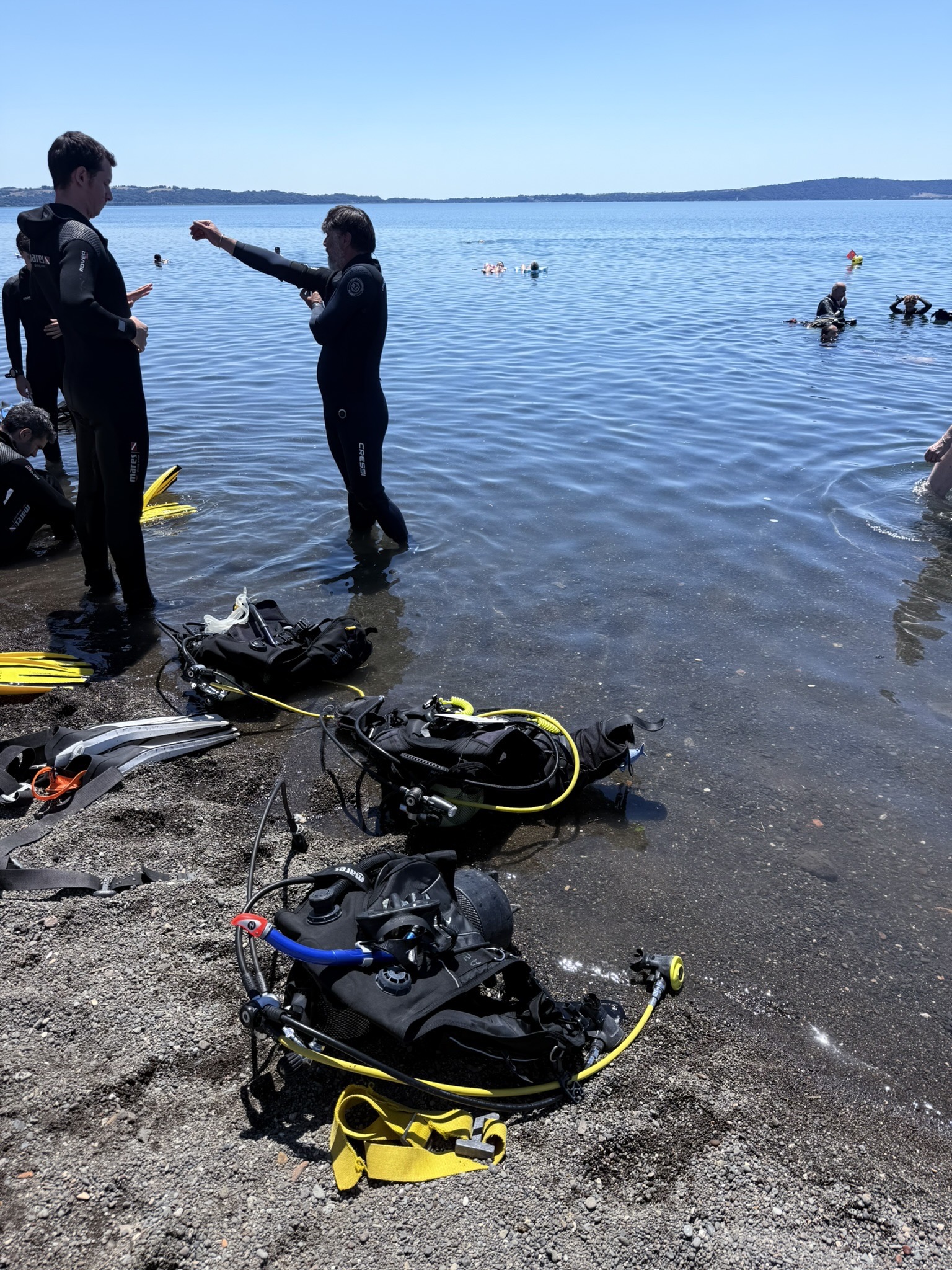
Trevignano Romano sits on the north shore of Lake Bracciano, a volcanic-tectonic crater lake 164 m above sea level that reaches 160 m at its deepest point. The dive is done from the beach: you walk in over sand, cross a bottom of weed and sand, and follow the slope out. ProDiving, which runs the site, is explicit that the Trevignano shore is steeper than the Bracciano one, and that 18 m comes up within a few metres of the shoreline. That is why Rome clubs use this end of the lake for deeper training rather than the gentler southern beaches. Entry points are spread along the lakefront, from via della Rena to the stretch local divers call the relittini.
What you see is a lake, not a sea dive. Dense weed stands to about 10-12 m, tall enough that a 2009 dive report on this lake describes it as trees at 8 m, and below it the bottom turns muddy and then sandy. Perch are the fish you meet most often; pike and carp are less common and mostly a summer sighting. Further out, at about 24-25 m, is a marked point divers call the Venere di Trevignano, reached in light that one logged dive compares to a night dive. That report does not describe what the object actually is, and neither does anything else we found.
Conditions are most of the story here. The first three metres are effectively blind and visibility only opens below about four; on a good day it is clear enough to navigate, and during an algal bloom it collapses. Acquazzurra puts the water between 14 and 20 C across the year and caps its dive at 30 m. Below that it gets colder fast: one logged dive recorded 10 C at 25 m against 21 C at the surface, and another 7 C on the bottom at 40 m on the Bracciano side of the lake. There is no current and no swell, and motorboats on Lake Bracciano are restricted to licensed fishermen, so nobody dives this from a boat.
OW
Shore entry from the lakefront at Trevignano Romano, on the north shore of Lake Bracciano, under an hour from Rome. Entry points are spread along the shore from via della Rena to the relittini. Cylinders and guiding come from Rome dive centres and clubs that run the lake as a day trip; Acquazzurra prices a shore dive here at EUR 20 including a cylinder. Motorboat use on the lake is restricted to licensed fishermen, so there is no dive boat.
You can reach the site independently.
None published specifically for diving. The lake has been inside the Parco Naturale Regionale di Bracciano-Martignano since 1999, and the Citta Metropolitana di Roma lake-navigation regulation governs boats and organised surface activities, with park authorisation required for races, organised swims, SUP events and the placing of buoys. We found no published rule requiring a permit for a shore dive, but that is an absence of evidence rather than a confirmation.
Lake Bracciano has been part of the Parco Naturale Regionale di Bracciano-Martignano since 1999. Motorboats are limited to licensed fishermen, and navigation and organised water activities are regulated by the Citta Metropolitana di Roma. Check current park and metropolitan rules before organising anything beyond an ordinary shore dive.
No source names a best month and the site is dived all year: Roman centres use it for courses in every season and specifically for restarting after the winter break. The trade-off is that the warmest water and the thickest warm layer come in high summer, which is also when algal blooms cut visibility hardest, so ask the centre what the lake is doing that week rather than picking a month in advance.
Flat water, no current, and a visibility profile that is the reverse of the sea: nothing in the first 3 m, opening up from about 4 m, and swinging through the year with algal blooms. 14-20 C at recreational depth by season, markedly colder below, with 10 C recorded at 25 m. Bottom is dense weed to 10-12 m, then mud, then sand.
On current: None. It is a closed lake with no tide and no source reports current. What changes with depth is temperature: 14-20 C near the surface depending on season, 10 C recorded at 25 m on one logged dive, 7 C on the bottom at 40 m on another. Plan exposure protection for the deepest part of the profile rather than for the entry.
The centres that run the site cap it at about 30 m, and the Trevignano shore reaches 18 m within a few metres of the beach, which is what distinguishes it from the shallower Bracciano side. The lake itself is far deeper, 160 m at its deepest point, but that is not part of any dived profile here. The marked point known as the Venere di Trevignano sits at roughly 24-25 m.
Yes, with a caveat. Acquazzurra rates the dive easy and uses it for open water and advanced courses, and the entry is a straightforward walk in over sand. The caveat is that the first three metres have essentially no visibility, the water is 14-20 C by season, and 18 m comes up quickly on this shore, so it is an easy dive that still demands a diver comfortable in cold, dim, freshwater conditions.
It is inverted compared with the sea. The top three metres are effectively blind and visibility opens from about four metres down, where on a good day it is clear enough to navigate. Across the year it swings widely, and it collapses during algal blooms. One dive log describes conditions at 25 m as needing a torch, with light equivalent to a night dive.
Sources put the water between 14 and 20 C over the year at the depths normally dived. It gets colder quickly with depth: one logged dive recorded 10 C at 25 m against 21 C at the surface, and another recorded 7 C on the bottom at 40 m elsewhere in the lake. Plan exposure protection for the deepest part of your profile, not for the entry.
Freshwater, not reef. Dense weed stands to 10-12 m, in places tall enough that divers describe it as trees, then the bottom turns to mud and sand. Perch are the fish you meet most often; pike and carp are less common and mostly seen in summer. The site also holds the relittini, small submerged objects at the east end used for technical skills, and the Venere di Trevignano at about 24-25 m.
We found no published rule requiring a permit for an ordinary shore dive, though the lake has been inside the Parco Naturale Regionale di Bracciano-Martignano since 1999 and organised surface events need park authorisation. There is no dive-boat option: motorboat use on Lake Bracciano is limited to licensed fishermen, so every dive here is a shore dive.
The difference is the slope. ProDiving describes the Bracciano side as descending slowly, while on the Trevignano shore 18 m arrives within a few metres of the water's edge. That makes Trevignano the end of the lake used for deeper training and for certifications that need depth, and Bracciano the gentler option for first dives and shallow skills.
This is fresh water, so there is no reef life to log. We do not carry an occurrence record for inland sites: the scientific databases we use are marine, and the nearest records would come from whatever lake or river is in the search radius rather than from the water you dive.
SeaLog imports your dives from your dive computer or Apple Watch, tracks every animal you see, and keeps your logbook safe forever.
Download SeaLog