


Certification required
OW
 SeaLog
Egypt · reef · beginner
A shallow seagrass bay a few kilometres from Port Ghalib where the dugongs actually are, and where the dive plan is mostly hovering.
Marsa Mubarak is a large sheltered bay a few kilometres south of Port Ghalib on the Marsa Alam coast, and it is one of the two Egyptian sites - the other being Marsa Abu Dabab - where dugong encounters are a realistic reason to get in the water rather than a marketing line. The reason is the habitat: the bay has a shallow sandy bottom carpeted with seagrass meadows of Halophila and Halodule, which is dugong food, and one operator calls it one of the most reliable dugong grazing bays in Egypt.
The profile is undemanding. The centre of the bay sits at roughly 6 to 10 m and the outer parts run to 12 to 15 m, with coral blocks and pinnacles around the edges; the shallowest published band is 3 to 18 m. Current is negligible. Both shore and boat entry are used, and the site is sold to snorkellers, beginners and photographers on the same trip.
Our OBIS records here are dense and are the ordinary northern Red Sea reef community rather than the megafauna: bluespotted ribbontail ray, sohal surgeonfish, Klunzinger's wrasse, sailfin tang, broomtail wrasse, diagonal butterflyfish, Picasso triggerfish, sergeant major, common lionfish and live sharksucker all appear in quantity. The dugongs, turtles and eagle rays that people come for are dive-guide and operator reporting, not occurrence data.
Because the bay is shallow and calm, the animals are close to the surface and the temptation to crowd them is high; HEPCA's code of conduct is the constraint that makes the site work.
OW
Both shore and boat access are used. The bay is a few kilometres south of Port Ghalib, and operators run it as a half-day two-dive trip - one quotes 70 EUR per diver including hotel transfers.
You can reach the site independently.
The Egyptian Red Sea dugong-watching guidelines apply: keep 3-4 m off, observe for no more than 30 minutes, and use no motorised diver propulsion or underwater acoustic devices.
The bay sits inside the Egyptian protected-area system and a national-park entrance fee of roughly 5 USD is reported, waived for guests of the resorts on the bay and usually bundled into organised snorkelling tours; confirm the current figure locally. The dugong-watching code of conduct is the operative rule in the water: do not touch, ride, chase or feed the animals, keep 3-4 m off, cap the encounter at 30 minutes, and use no scooters or acoustic devices. Divers must keep clear of the bottom and must not move the sand or sit on the seagrass - the meadow is the reason the dugongs are in the bay at all.
The bay is dived year round and no source publishes a seasonal peak. What operators do say is that dugongs feed more actively around tidal changes, and that early morning and late afternoon - when the bay is quieter - give the better chance of an undisturbed encounter.
A sheltered, shallow bay with negligible current. Roughly 6-10 m through the middle and 12-15 m on the outer side, over sand and seagrass, with coral blocks around the edges. Visibility is reported at 12-22 m; the conservative 12 m is recorded. The site works year round, and dugongs are reported to feed more actively on tidal changes.
On current: Current is reported as negligible. Visibility is quoted as a 12-22 m range; we record the conservative lower bound. Depth figures disagree - one operator publishes 3-18 m and another describes 6-10 m in the middle of the bay and 12-15 m on the outer side, while PADI lists a 30 m maximum for the record. We take the conservative 3-18 m, which matches every description of what the dive actually is.
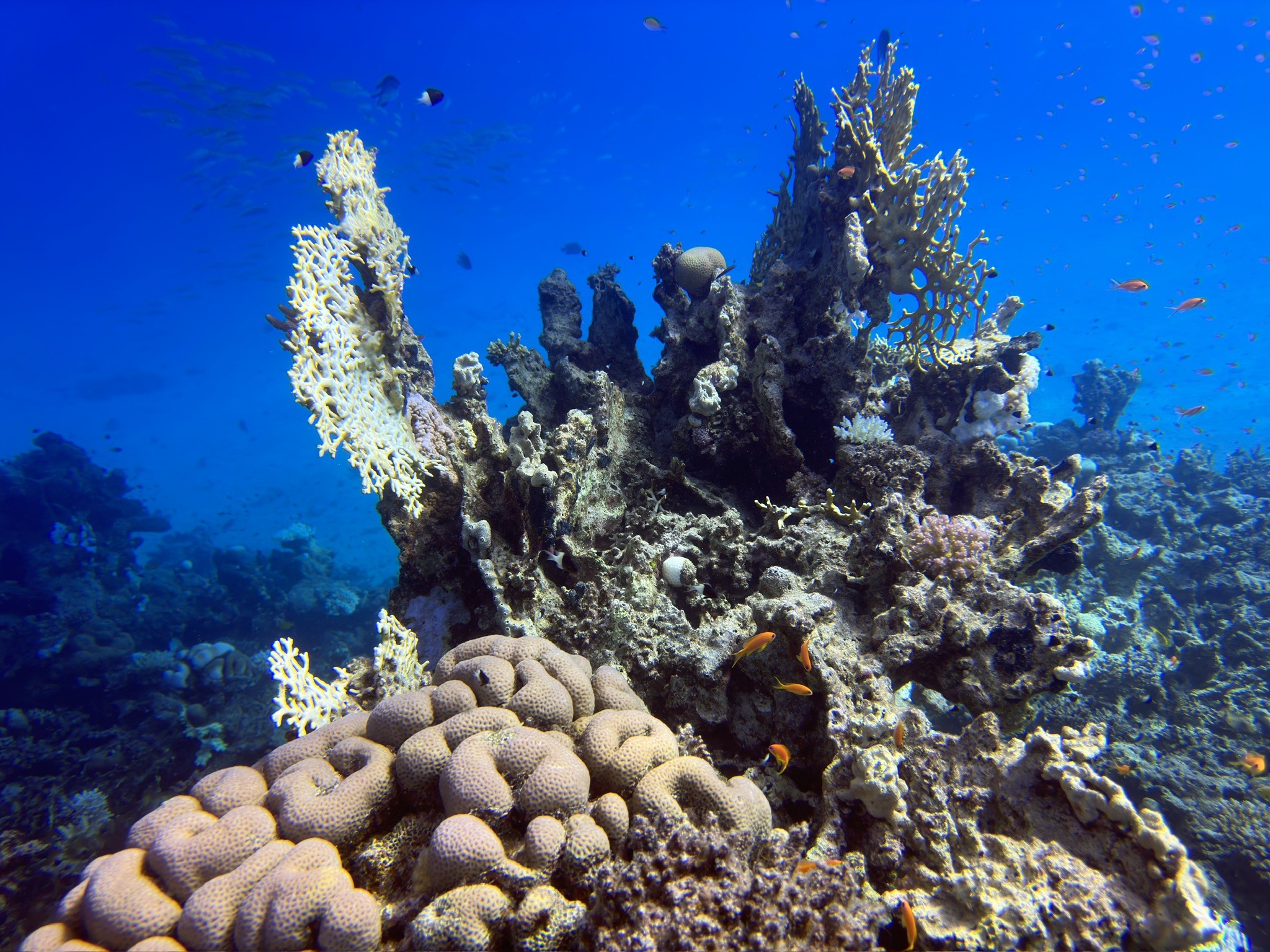
It is one of the two Egyptian bays where the answer is a genuine yes rather than a slogan, the other being Marsa Abu Dabab. Dive Marsa Alam calls it one of the most reliable dugong grazing bays in Egypt, and the reason is the Halophila and Halodule seagrass meadows carpeting the bay. It is still a wild animal and still not guaranteed.
Shallow. The published range is 3 to 18 m, with roughly 6 to 10 m through the middle of the bay and 12 to 15 m on the outer side. PADI's record lists a 30 m maximum, which does not match any description of the dive; we record the conservative figure.
Yes, and for the dugongs it may be the better choice. The bay is calm, shallow and effectively current-free, the seagrass is near the surface, and a grazing dugong comes up to breathe every 30 to 40 seconds. Stay at the surface with your group rather than diving down onto a feeding animal.
Very. Current is negligible, the profile is shallow, and Open Water is the stated minimum. The one skill that genuinely matters is buoyancy: the seagrass meadow is the reason the animals are there, and it does not survive being knelt on.
A national-park entrance fee of roughly 5 USD is reported for the bay, waived for guests of the resorts on it and usually included in organised tours. In the water: no touching, riding, chasing or feeding, keep 3 to 4 m away, cap the encounter at 30 minutes, no motorised propulsion and no acoustic devices. Divers must stay off the bottom and must not move the sand or sit on the seagrass.
The bay is dived year round and no source gives a best month. Time of day matters more: early morning or late afternoon, when the bay is less crowded, gives the better chance of a calm encounter, and dugongs are reported to feed more actively around tidal changes.
Our OBIS records for the bay are dense and are ordinary Red Sea reef fauna rather than megafauna: bluespotted ribbontail rays, sohal surgeonfish, Klunzinger's wrasse, sailfin tangs, broomtail wrasse, butterflyfish, Picasso triggerfish and lionfish. Operators also report green turtles and eagle rays around the coral blocks at the edges of the bay.
| Species | How often | Records |
|---|---|---|
| Taeniura lymma | common | 108 |
| Acanthurus sohal | common | 84 |
| Thalassoma rueppellii | common | 78 |
| Zebrasoma desjardinii | common | 73 |
| Cheilinus lunulatus | common | 69 |
| Chaetodon fasciatus | common | 66 |
| Rhinecanthus assasi | common | 64 |
| Abudefduf vaigiensis | common | 63 |
| Pterois miles | common | 61 |
| Chlorurus sordidus | common | 59 |
| Chaetodon auriga | common | 54 |
| Paracirrhites forsteri | common | 53 |
| Heniochus intermedius | common | 53 |
| Naso elegans | common | 51 |
| Chaetodon semilarvatus | common | 51 |
| Gymnothorax javanicus | common | 50 |
| Fistularia commersonii | occasional | 49 |
| Echeneis naucrates | occasional | 49 |
| Zebrasoma xanthurum | occasional | 46 |
| Naso unicornis | occasional | 46 |
| Pseudanthias squamipinnis | occasional | 44 |
| Monotaxis grandoculis | occasional | 43 |
| Pygoplites diacanthus | occasional | 43 |
| Arothron hispidus | occasional | 42 |
| Cephalopholis argus | occasional | 41 |
| Diodon hystrix | occasional | 40 |
| Chaetodon austriacus | occasional | 39 |
| Tridacna maxima | occasional | 39 |
| Coenobita scaevola | occasional | 37 |
| Parupeneus forsskali | occasional | 36 |
| Scarus niger | occasional | 36 |
| Ctenochaetus striatus | occasional | 36 |
| Amphiprion bicinctus | occasional | 36 |
| Arothron diadematus | occasional | 35 |
| Pomacentrus sulfureus | occasional | 34 |
| Priacanthus hamrur | occasional | 34 |
| Epibulus insidiator | occasional | 33 |
| Amblyglyphidodon indicus | occasional | 33 |
| Dugong dugon | occasional | 32 |
| Mulloidichthys vanicolensis | occasional | 32 |
| Halichoeres hortulanus | occasional | 31 |
| Canthigaster margaritata | occasional | 31 |
| Acanthurus nigrofuscus | occasional | 29 |
| Mulloidichthys flavolineatus | occasional | 28 |
| Cephalopholis miniata | occasional | 28 |
| Corythoichthys flavofasciatus | occasional | 28 |
| Neoniphon sammara | occasional | 27 |
| Scolopsis ghanam | occasional | 26 |
| Balistoides viridescens | occasional | 26 |
| Abudefduf sordidus | occasional | 26 |
| Chaetodon paucifasciatus | occasional | 25 |
| Pycnochromis dimidiatus | occasional | 25 |
| Cyclichthys spilostylus | occasional | 24 |
| Pseudobalistes fuscus | occasional | 23 |
| Chrysiptera unimaculata | occasional | 22 |
| Aluterus scriptus | occasional | 22 |
| Myripristis murdjan | occasional | 22 |
| Epinephelus tauvina | occasional | 22 |
| Parapercis hexophtalma | occasional | 22 |
| Sufflamen albicaudatum | occasional | 22 |
| Scarus ferrugineus | occasional | 13 |
| Chlorurus gibbus | occasional | 13 |
| Pseudobalistes flavimarginatus | occasional | 12 |
| Parupeneus cyclostomus | occasional | 12 |
| Dascyllus abudafur | occasional | 11 |
| Rastrelliger kanagurta | occasional | 11 |
| Aetobatus ocellatus | occasional | 10 |
| Hemiramphus far | occasional | 10 |
| Ostorhinchus cyanosoma | occasional | 10 |
| Balistapus undulatus | occasional | 10 |
| Hipposcarus harid | occasional | 10 |
| Coris aygula | occasional | 9 |
| Flavocaranx bajad | occasional | 9 |
| Chromis viridis | occasional | 8 |
| Abudefduf sexfasciatus | occasional | 8 |
| Dascyllus trimaculatus | occasional | 8 |
The southern leg of the Three Corners Fayrouz house reef: lagoon inside, vertical wall outside, entered off a 368 m jetty.
The northern end of the Three Corners Fayrouz Plaza house reef at Port Ghalib: a shallow lagoon behind a reef flat, a pontoon to get past it, and a near-vertical drop-off on the outside.
A narrow V-shaped crack in the fringing reef south of Marsa Mubarak, dived along its two walls and rarely visited.
The Palace jetty entry onto the Port Ghalib house reef: stairs into the water, then north or south along a wall that runs past 30 m.
SeaLog imports your dives from your dive computer or Apple Watch, tracks every animal you see, and keeps your logbook safe forever.
Download SeaLog